Angle Iron and Good Sense: A Fixture Audit for Lines That Keep Fixing the Same Mistake
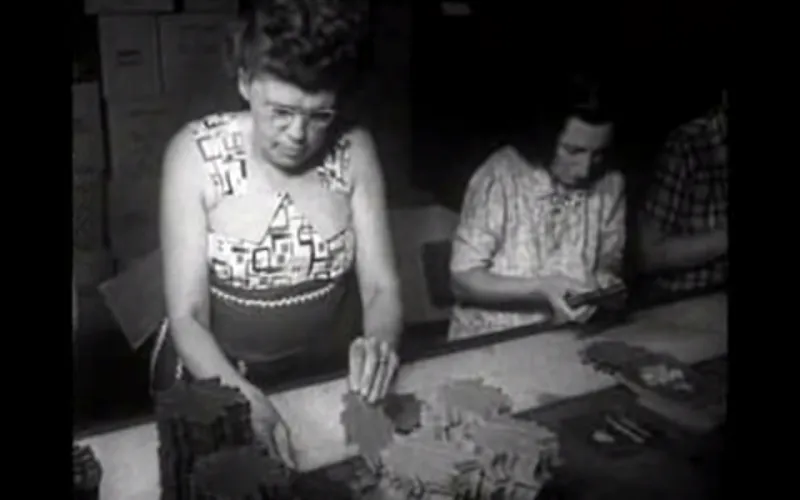
Photo: National Association of Manufacturers; Prelinger Archive, Public Domain, via Wikimedia Commons
Every plant has a scrap report with a number on it that makes somebody wince. Two thousand dollars in rework, a torn-down build, a truck sitting at the dock. That number gets a meeting and a corrective action form. What never gets a meeting is the twenty-dollar stop block that would have made the whole event impossible. That is the trade we should be making, and it starts with a walk down the line instead of a meeting in the conference room.
Start With the Rework Log, Not the Tooling Catalog
Pull the last quarter of nonconformance reports and look for repeats, not one-offs. Same part number, same operation, same failure mode, three or more times. That pattern is telling you something specific: the station allows a wrong outcome and depends on a human being to catch it every single cycle. Nobody is that consistent, especially at hour nine. When you find the repeat, write down the exact geometry of the mistake. Backward bracket. Upside-down housing. Seal face resting on a bench top. Those are fixture problems wearing a discipline costume.
The Three-Minute Stand-and-Watch
You do not need a stopwatch or a clipboard for this. Stand at the station and watch three full cycles. Ask yourself a short list of questions while the operator works.
What here can go in backward, upside down, or one hole off? Where does the operator hold the part with one hand while the other hand does the actual work? That is a cradle waiting to be built. Where is somebody marking an alignment with a paint pen that wears off by lunch? That is a stop block or a locating pin. Where does a hose or a harness have to route a specific way and gets pinched instead? That is a guide, a clip, or a formed wire.
Write the answers on the back of a traveler. Keep it ugly. The information matters more than the format.
What Counts as a Fixture
Cheap and dumb is the goal. Stop blocks, cradles, locating pins, tilt stands, gravity chutes, dummy connectors, a piece of UHMW with a groove milled in it. The material list is short: scrap angle iron, plywood, 80/20 offcuts, Delrin, a 3D-printed guide that lasts a month. Print another one next month. The maintenance crib has a scrap bin and the scrap bin is faster than any supplier portal. McMaster-Carr can have it to you tomorrow; the bin has it now.
A fixture does not need to be permanent to be useful. It needs to remove one specific wrong option from the station. That is the whole job.
Build It Ugly, Prove It Fast
Give yourself a two-week rule. Sketch the idea, walk it to the maintenance tech, and build a prototype in under an hour. Run it for one shift. Count the misassemblies before and after. If the number does not move, throw it in the steel bin and do not mourn it. Most fixture ideas are wrong, and finding that out for twenty dollars is a bargain.
If the number does move, paint it yellow, label it with the station and the date, and write it into standard work. A fixture that lives on the bench but not in the work instruction is a fixture that disappears the first time somebody cleans up.
Three That Paid for Themselves
A three-inch angle-iron stop bolted to a bracket press kept a weld nut from being loaded backward. Material cost was about fourteen dollars and it took a millwright most of a lunch break to drill and mount. Rework on that operation had been running around forty units a month.
A UHMW cradle for a pump housing held the seal face off the bench top and stopped the nicks that kept showing up at final inspection. Twenty-two dollars in material, cut on a band saw.
A plywood shadow board with a dummy connector, one that only mates the correct way, cut new-hire training on a harness station from about a week to a day and a half. Nine dollars and an afternoon.
None of those are engineering marvels. They are the kind of thing a good assembler sketches on a napkin and a maintenance tech makes real before the end of the shift.
When a Fixture Is the Wrong Answer
Be honest about the limit. If the defect is a missing fastener because the torque tool is out of calibration, a bracket will not save you. If people are skipping a step because the takt time is impossible, a fixture just makes bad work go faster. Fix the tool, fix the staffing, fix the standard first. Fixtures handle geometry and sequence. They are not a cover for a broken process, and putting one in place of a real fix just freezes the problem in place.
The Payback Math Nobody Argues With
Run the number once and keep it on the board. One rework event usually costs somewhere between three hundred and two thousand dollars once you add teardown labor, rebuild labor, scrap, freight, and the hole it puts in the schedule. A fixture that costs a day of maintenance time and twenty-five dollars in material pays back on the first avoided event. Every time after that is free.
Keep a running list: station, defect, fixture idea, cost, date proven. Managers fund things that have dates and numbers attached. Give them both.
The goal is not to build a museum of jigs. It is to make the right way the easy way. Fixtures work because they are dumb and patient. They do not get tired at two in the morning and they do not skip the check because the line is behind. If your line keeps rebuilding the same mistake, the answer is probably not another training session. It is a piece of angle iron and a Saturday morning.