The Two-Minute Bridge: A Shift Handoff That Carries Quality Across the Clock
Walk through a plant at shift change and you can feel the gap. The outgoing crew is tired, the incoming crew is waking up, and somewhere between the time clock and the first station, a pile of useful information evaporates. The fixture that ran a little warm after lunch. The bin of brackets that came in undersized. The torque driver that needed a second squeeze to register. None of it makes it into the next shift's head, so the next shift learns it the hard way.
That gap is not a paperwork problem. It is a quality problem wearing a paperwork costume. A good handoff is not about proving you did your job. It is about making sure the next person does not have to fight the same gremlin twice.
The ninety-second memory problem
Most shift handoffs are verbal, fast, and optimistic. Someone says, 'Line three is running good, but watch the press.' That sentence might mean there is a hairline crack in a fixture, a sensor that drifts when the room gets warm, or a part supplier who changed the coating. The next operator hears 'watch the press' and watches the wrong thing for two hours.
By the time the problem shows up again, the person who knew the context is gone. Maybe they are asleep. Maybe they are on a weekend. Either way, the next crew pays for a detail that could have taken thirty seconds to write down.
The fix is not a forty-field form. It is a short bridge between two shifts. One page, five fields, written by the outgoing lead or operator and read by the incoming one before the first part gets built.
A one-page note, not a novel
Call it a turnover note, a shift bridge, or a handoff sheet. The name matters less than the discipline. The note should fit on one side of a page and take about two minutes to complete. If it takes longer, people will skip it on the nights when it matters most.
Here is the structure that works on an assembly floor: open quality flags, fixture quirks, part shortages, the one thing the next shift must watch, and the next move. That last field is easy to forget. A handoff that only says 'press is acting up' leaves the next crew to guess whether they should run it, tag it out, or call maintenance. A handoff that says 'press is acting up; run left-hand parts only until maintenance checks the die; call Dave if the tonnage light flickers' gives them a decision.
Open quality flags
Start with anything that is already flagged. A part on hold, a first-article waiting for sign-off, a suspect lot pulled from the line, a customer complaint that may trace back to a specific station. Keep it factual and short. 'Six units from station 4 on hold for burr check' is enough. The next shift does not need the full saga. They need to know what is still open and who owns it.
This field should also include anything that was fixed but not verified. If maintenance adjusted a stop, or a team leader swapped a worn guide, say so. A fix that has not been proven over a full run is not finished. The next shift should know to watch it, not assume it is solved.
Fixture quirks
Every line has a few pieces of tooling with personalities. A clamp that needs to be seated by hand. A locating pin that sticks in cold weather. A vision camera that dislikes glare from the skylight at 3 p.m. These quirks are not failures. They are operating knowledge. But they only help if they are passed along.
Write down the quirk and the workaround in the same breath. 'Fixture B needs a firm push on the left side before the clamp cycles' is useful. 'Fixture B is finicky' is not. The goal is to give the next operator a physical action, not a mood.
Part shortages and substitutions
Nothing eats a shift's start-up time like discovering a bin is short after the line is already running. The turnover note should list any part that is low, late, or substituted. Include the bin location if it helps. If an engineer approved a temporary substitution, write that down too. The next shift should not have to call three people to confirm what is already sitting on the line.
This is also the place to note any packaging changes. A new supplier box that looks almost identical to the old one can cause a mix-up at 6 a.m. A quick line like 'new box for part 4471 has blue tape, not red' saves a scrap event.
The one thing to watch
This is the heart of the note. Ask the outgoing crew to name the single issue most likely to cause rework on the next shift. Not a list of ten concerns. One thing. The press that needs a warm-up cycle. The connector that seats hard when the humidity drops. The new operator on station 2 who is doing fine but still needs a second look at the final torque check.
One thing is memorable. One thing gets watched. A list of ten gets skimmed and forgotten.
The next move, not just the problem
For every open item, write the next action. Who should look at it, what should they check, and when should they escalate. This is where the handoff becomes a decision tool instead of a complaint log. 'Watch the press' becomes 'check tonnage at 10 a.m.; if it drifts, tag out and call maintenance.' That is a handoff the next shift can actually use.
How to make it stick on a busy line
Keep the form clipped to the station board or taped inside a clear sleeve. The incoming lead reads it during the first five minutes of the shift, before the line gets loud. The outgoing lead fills it out during the last ten minutes, not after the whistle. If a line is running hard, the note can be three sentences. A short note that gets written beats a perfect note that gets skipped.
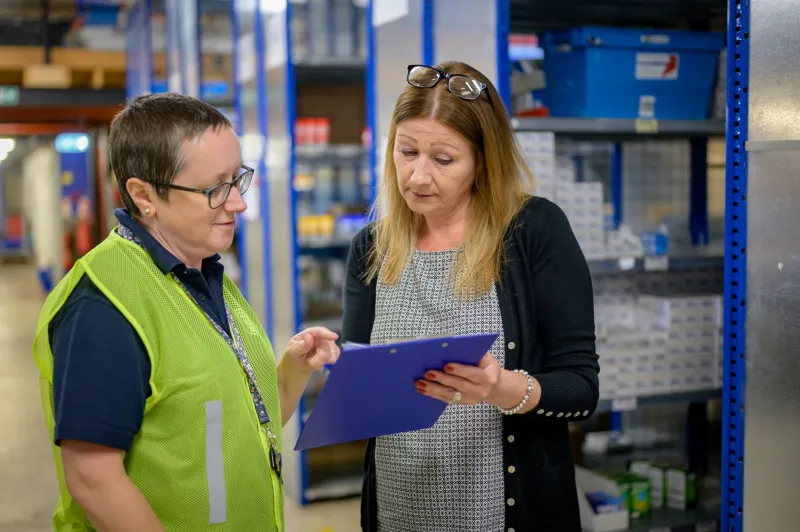
It also helps to do a ninety-second readout at the station. The outgoing lead points to the open flag, names the one thing to watch, and hands over the note. That small ritual gives the next crew a clean start and gives the outgoing crew a reason to say what they actually saw.
What changes when the handoff gets good
You will not notice it as a dramatic win. You will notice it as fewer repeat problems. The same fixture issue stops showing up on both shifts. The part shortage gets handled before the line starts. The new operator gets support instead of a surprise. Start-up time gets shorter because the next crew is not spending the first hour reconstructing the last hour.
A handoff is a product your shift builds for the next one. Make it short, make it specific, and make it useful. The next crew will thank you by keeping the line running.